The recent visit by the Princess of Wales to Reggio Emilia has highlighted the Reggio Emilia School of early years education. The Reggio Emilia approach focuses on the child’s innate ability to learn and encourages that through the environment and a facilitating approach to learning. I had the honour through Ermes Bertani and his sister Bice Bertani to visit the school in Sesso. Its wide building and rooms immediately communicated the sense of learning as an exciting journey. The classrooms were airy and open onto the grounds through large windows.
What is less dwelt on is that this school of teaching is inextricably linked with the political – with how one conceives of the Polis. In the 1940s, Italy was emerging from 20 years of fascism. To fascism, education is a way of creating obedient masses. Reggio Emilia and Emilia Romagna more generally was at the heart of resistance to fascism. To have this school in this town is no coincidence.
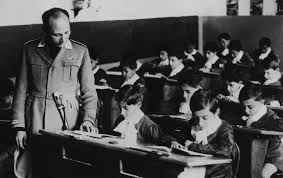
Even just the idea of a nursery with children free to bring in leaves, or a secondary school in which children decide what they would like to learn next (see the work of Bruno Ciarli in the 1950s in Bologna), or a university which allows for the student’s previous learning, are all countervailing to this linear, unidirectional view of education.
That is not to say that we teach nothing or do not need to have knowledge, but we respect our students as people with their own funds of knowledge, analysis and instinct. Sometimes these are small but important factors, such as rearranging the seats in a classroom to create more equality and discussion.
Sometimes, it involves the university professor accepting multi directional transfer of knowledge rather than preparing a knowledge dump. Students are not blank pages but learners who come with their own brains and set of approaches. The task is to activate them.
This starts in my view with professorial holdback. This is a sign of eminence rather than the opposite. I remember going to a seminar at university with Jonathan Wordsworth. Students had flocked across the university to his seminar. He finished our reading of a poem with the reflection: That was very moving. After our shock that we were not to be given dicta from the god, his holdback freed us up to hold one of the best student discussions I ever had.
Fascism may or may not be on the rise but other elements create the pressure to uni directional teaching. The first in the current higher education context is the student as consumer, who has paid for a degree and expects the service towards the purchase without being required to learn actively. This is a crude characterisation but many teachers will recognise it.
The second challenge is more subtle. AI completely removes dependence from the teacher. It provides content and completely bypasses student- teacher engagement. I now accept that as teachers we have to show students how to engage, but the task seems to take us further from creation of a fully formed human being who lives in the city, the polis, which after all is the best justification for universities rather than degree factories.
Reggio Emilia can teach university teachers. The pedagogical is political.
 Londonlawcalling