Visitors to Rajasthan in India see its palaces and houses of pretty red and pink sandstone. Yet the work of quarrying and cutting that stone is costing workers their lives.
On October 18th, on the outskirts of Jaipur, I participated in an important consultation on Business and Human Rights in the Mining Sector organised by the excellent Mine Labour Protection Campaign. Rajasthan is the second resource richest state in India for mineral and stone mining. The quarry work is done across the state both in big mines, such as the Vedanta mine at Zawar outside Udaipur, which I had visited a couple of days before, and smaller mines, which I had visited the previous day outside Jodhpur (many thanks to Advocate Idrish Mohammed for organising the Jodhpur visits and for his insights).
Regulation of stone mining is shared between the All-India Ministry of Mines and the Rajasthani state level Department of Mines & Geology. A system of Rajasthan- administered licenses for mining is in place to attempt to regulate the sector.
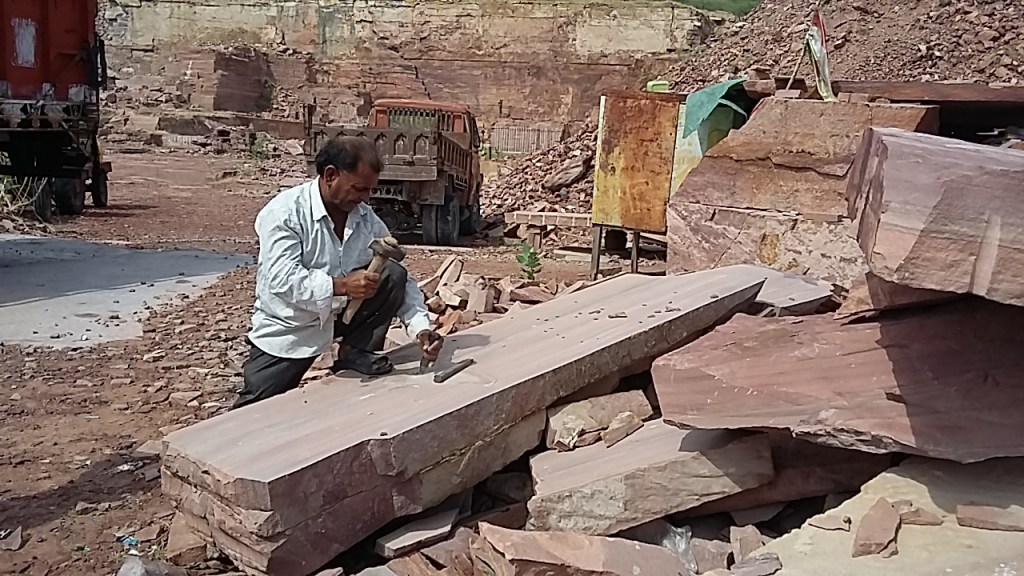
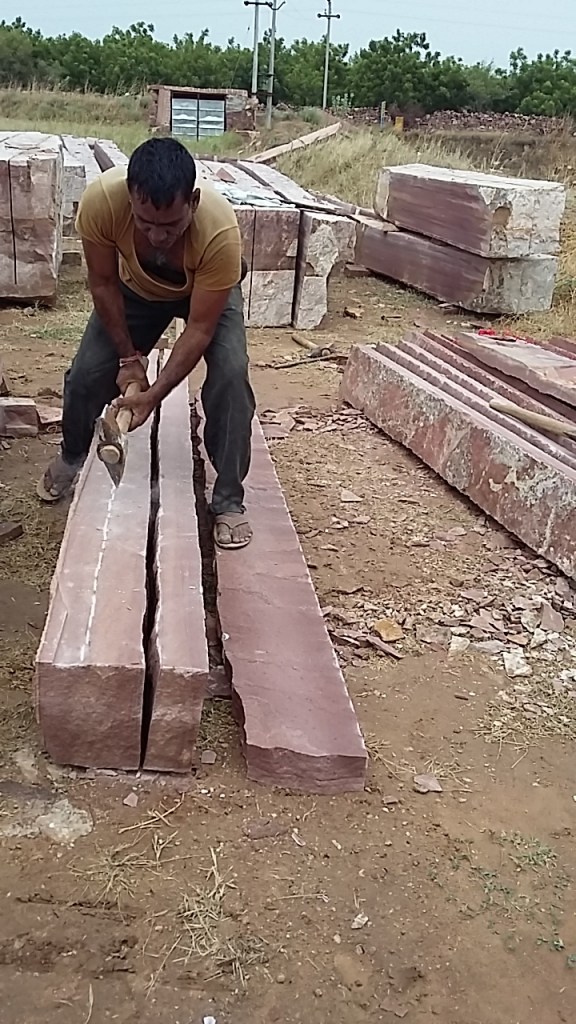
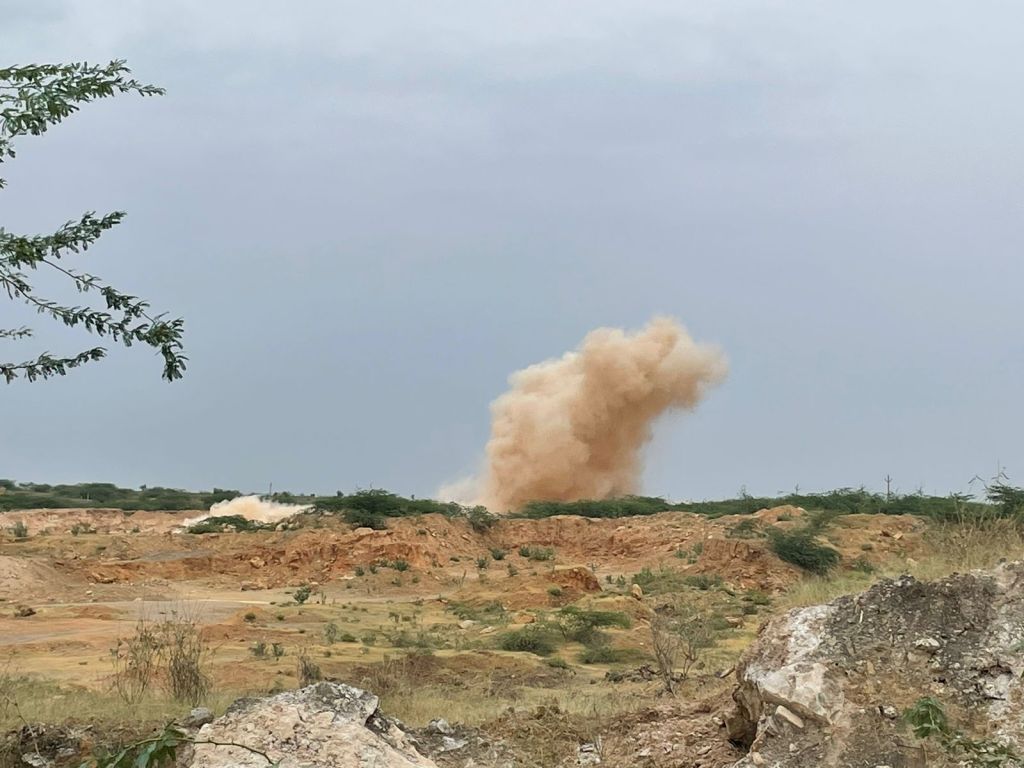
The consultation discussants, from all over India, identified connected problems of low wages and poor working conditions. The focus, however, was on the tens of thousands of workers who have died, and who continue to die, from silicosis. This is a respiratory disease which is caused by inhalation of crystalline silica dust. The worker’s lungs are irreversibly hardened and scarred.
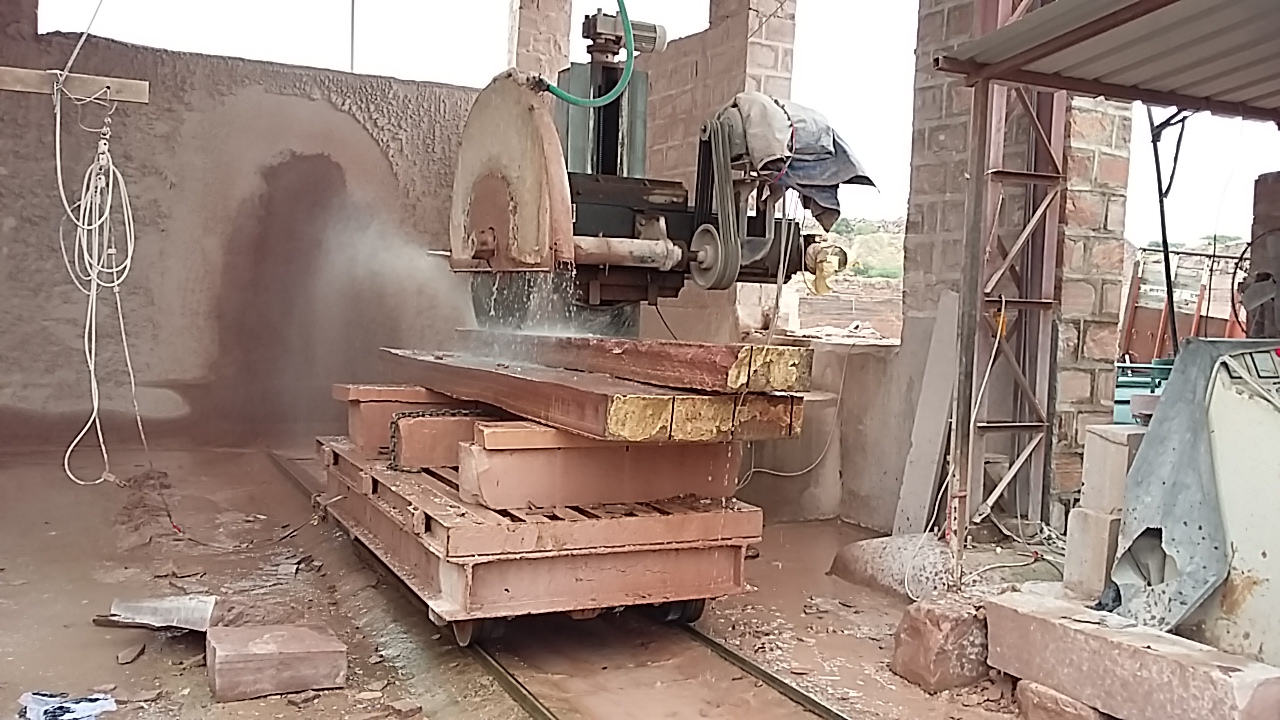
The focus of discussion was how to prevent the disease and how to compensate workers or their bereaved families. Medical evidence suggests silicosis can be avoided by greater automation of drilling and cutting and to some extent by mask wearing. While this is more or less implemented in the large mines, it is less so in the smaller mines which operate outside formal licensed systems. Wet drilling for example, prevents contraction of the disease or significantly diminishes the risk.
There is another big obstacle to protection, respect and remedy for these workers. Any discussion about labour rights in India has to include the fact that an overwhelming percentage of workers (estimated at 93%) work in the informal, otherwise termed unorganised, sector. Distinctions have to be made here between the informal sector and informal work, which together form the informal economy. Informal work is defined by the ILO at the ICLS 15th session as “all remunerative work (i.e. both self-employment and wage employment) that is not registered, regulated or protected by existing legal or regulatory frameworks, as well as non-remunerative work undertaken in an income-producing enterprise. Informal workers do not have secure employment contracts, workers’ benefits, social protection or workers’ representation.” The role of informality in India and other South Asian countries was discussed by myself and others at an Oxfam India 2020 seminar.
In 2013-14, the Ministry of Labour issued a Report in which they described informal labour as Labour relations – where they exist – are based mostly on casual employment, kinship or personal and social relations rather than contractual arrangements with formal guarantees. They quoted the First Indian National Commission on Labour (1966- 69) which defined the unorganised sector workforce as –“those workers who have not been able to organize themselves in pursuit of their common interest due to certain constraints like casual nature of employment, ignorance and illiteracy, small and scattered size of establishments”. Most importantly, the Commission on Informal Labour produced the Sengupta Report which examined the different ways of working grouped under the broad umbrella. A product of one of its recommendations, The Unorganised worker Social Security Act 2008 defines the “unorganised sector” as an enterprise owned by individuals or self-employed workers and engaged in the production or sale of goods or providing service of any kind whatsoever, and where the enterprise employs workers, the number of such workers is less than ten.
Informality is thus a very broad term which needs precision in each particular context. In the sandstone mining sector, it may involve working in small mines with no licenses or working in licensed mines, but with no labour regulation. As noted in the Sengupta Report, informal wage work in the formal sector is growing. Workers may have no written contracts setting out their pay and hours. This may lead to long unsafe hours of working. There may be lack of clarity as to who the employer is. Many mines are managed by agents. Workers are more likely to be dismissed out of hand and to have to move to another mine, leading to exposure from a variety of mine work. These workers are less likely to have the bargaining power to seek safe conditions and fair pay. If they contract silicosis, they may be unable to prove who they worked for and their status.
Four core ILO Conventions set out steps to promote collective bargaining CO 87 and 98 and on health and safety at work CO 155 and CO 187 . However, although they form part of the Declaration and thus bind India as an ILO member, they are not yet ratified by India, leading, it can be argued, to a lack of focus on building up these capabilities.
The State of Rajasthan has issued policies on silicosis. Since 2021, the State has implemented an automated portal for state compensation claims. These are fixed tariffs which do not fully compensate for loss. Tort law claims face formidable obstacles: lack of evidence of the employment relationship; medical evidence which often misdiagnoses; lack of funding for claims; and the slow pace of litigation in the Indian courts. The very people who need compensation by law most are in the worst position to assert their rights.
At the same time, digitalisation is enabling greater monitoring of the stone itself. Since the Rajasthan Minerals (Prevention of Illegal Mining, Transportation and Storage) Rules, 2006, any load leaving a mine and headed for market must be logged and then monitored on its journey. This is called an e-rawanna. I witnessed in one mine the weighing of a truck laden with stone. Its weight, destination, estimated time of arrival and plate were all logged in. Failure to arrive in time or at all caused the load to become unauthorised and thus to lose access to the formal market.
The conference concluded in the agreement of a proposal to the State of Rajasthan. The proposal is that when applying for a license, and uploading the application, the applicant should also list their workers. This proposal has the merit that it encourages registration and formalisation of workers. The applications can be made via an app and, has been said above, much of the sector is already digitalised. The State is in the run up to elections, but there is optimism that this proposal may be acceded to, and no real arguments against it. It has a dual outcome of encouraging licensing and taking a step towards greater visibility of workers.
Does the formal sector have a role to play? I have heard mining sector business representatives who, perhaps feeling that this reflects badly on their sector, deny that there is a problem at all, while also saying that the informal sector is invisible to them. In some cases, mines in the formal sector have informal / unorganised workers working for them. The formal sector has a role to play to identify and formalise their workers. As regards encouraging safe practice in informal mines, the competitive principle may be at play but since the sector as a whole suffers the reputational damage, promotion of safe practices has the logic of self-interest.
Again, thinking of the sector as a whole, where does this stone go? As is well known, supply chains are constantly snaking into different direct and indirect routes, domestic and export. In a 2021 ILO Report, it was identified that supply chain agreements had no focus on sustainability but instead focused on repeat business, large volume orders and timely payments. Some tracing is possible. A 2020 study by Charan and others , looking at the export business, identified that – at the time examined – 73% of sandstone went to the port of Mundra and of that, 90% to the UK. One large UK company is Marshalls , which reported that it supported a multi-lateral consultation in Brussels on the health of Indian workers in the quarrying and mining sector, with the Rajasthan Mine Workers Welfare Board. In the case of sandstone now headed for the EU market, many EU countries, notably France and Germany now have national due diligence laws. An EU Directive on corporate accountability down supply chains is on its way. In addition, in the UK, a parent company may have assumed responsibility over its subsidiaries or its supply chain sellers so as to have assumed liability in tort law, for which see Vedanta and Shell.
Prevention is paramount. One conference participant’s lament still sounds: “I have not prevented a single person dying from silicosis”. The search continues to protect this most basic of human rights from the impact of stone cutting business activity, to respect that right through positive state obligations, and to effectively remedy breaches. Together, these may encourage those who have economic monopsony power – whether they are buyers of work, or buyers of the stone the workers produce – to find safe working methods for those who work with sandstone but have no countervailing power to protect themselves.
 Londonlawcalling
wow!! 18You forgot that I was a seed
LikeLike