Thoughts from Livorno: Slavery, Freedom and Unfreedom
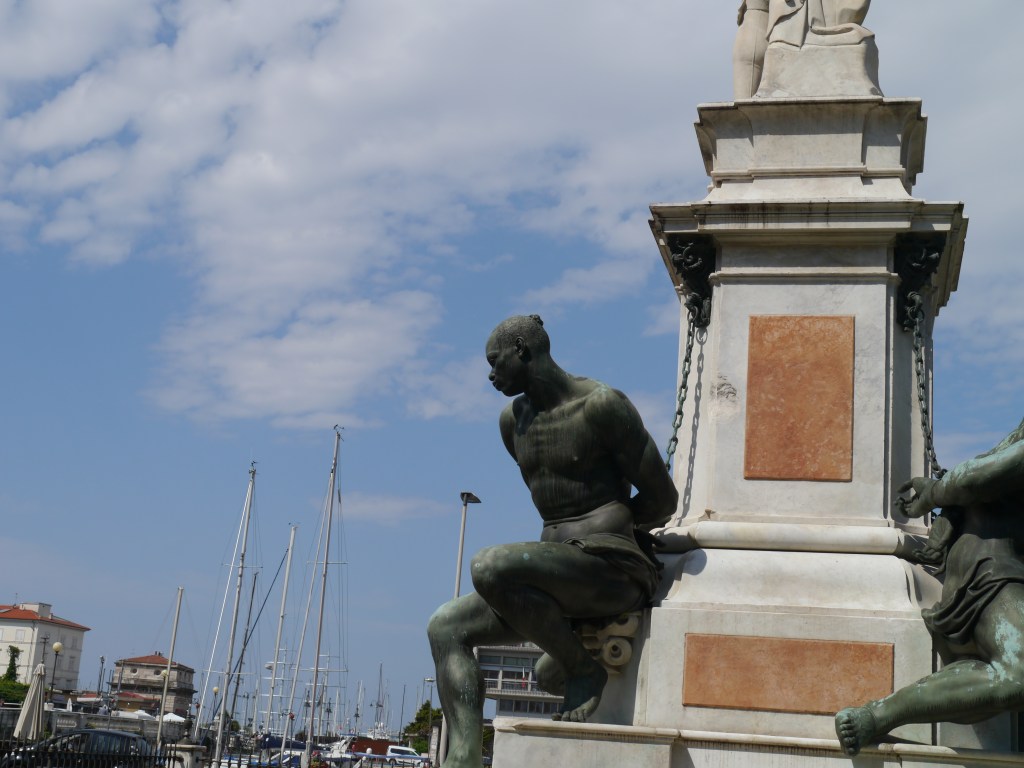
I was in the port of Livorno earlier this week on my way back to London from the beautiful islands of Elba and Pianosa. Now Tuscany’s third biggest city, it remains an important port but in the late sixteenth century, it was the largest slave trading port for the Medici economic empire, with long and deep use of slavery to maintain the economic system. I walked along the seafront to the statue in Piazza Michele now known as the four ‘Moors’ but initially solely Bandini’s 1599 statue of Ferdinand I. The art historian Mark Rosen has documented life for slaves in the free port of Livorno (at its height numbering 8% of the population), centred on the bagni. He examines Piero Tacca’s 1621-6 addition of the plinth and enslaved figures to the monument and his likely use of models from Livorno. Termed naturalistic by Rosen, some might say humanist, the plinth becomes more than a footnote to Ferdinand’s glory. Rosen comments: Because the monument itself was glimpsed daily by a polyglot population of merchants, religious refugees, and bound and unbound servants, viewers increasingly recognized these slaves as grounded in the experience of contemporary Livorno rather than simply resorting to type. Some banners about the Italian floods are draped across its plinth. No one around me looks at the figure of Ferdinand I above.
My favourite poet at school and university was Percy Bysshe Shelley, who wrote Ozymandias about a monument to power. In 1822, he drowned while sailing away from Livorno to nearby Lerici, and was cremated on a beach on a hot summer’s day. Therefore, a stay in Livorno triggered thoughts of Shelley. His long lyrical drama, Prometheus Unbound, was written in Italy in 1818-9 and published in 1820. The title recalls tragedies by Aeschylus, Prometheus Bound and UnBound, in which the hero Titan is punished for bringing fire to humans by being chained to a rock and having his liver pecked out, renew and pecked out again each day by an Eagle sent by cruel Zeus and was then pardoned.
Shelley’s poem, instead, is a fearless paen to liberation. He explains his move from the plot of Aeschylus: I was averse from a catastrophe so feeble as that of reconciling the Champion with the Oppressor of Mankind. The respective conditions are despot and slave (Act IV) and the word slave is used 7 times in the poem to describe Prometheus and the state of man around him. Through mental non-violent liberation, and with the help of Asia and Panthea, and Demorgorgon. he dissolves the power of Zeus. The poem ends as a celebratory liberation of man, hitherto captive. The end is worth setting out in full.
| DEMOGORGON Man, who wert once a despot and a slave, A dupe and a deceiver! a decay, A traveller from the cradle to the grave Through the dim night of this immortal day: ALL Speak: thy strong words may never pass away. DEMOGORGON This is the day which down the void abysm At the Earth-born’s spell yawns for Heaven’s despotism, And Conquest is dragged captive through the deep; Love, from its awful throne of patient power In the wise heart, from the last giddy hour Of dread endurance, from the slippery, steep, And narrow verge of crag-like agony, springs And folds over the world its healing wings. Gentleness, Virtue, Wisdom, and Endurance– These are the seals of that most firm assurance Which bars the pit over Destruction’s strength; And if, with infirm hand, Eternity, Mother of many acts and hours, should free The serpent that would clasp her with his length, These are the spells by which to reassume An empire o’er the disentangled doom. To suffer woes which Hope thinks infinite; To forgive wrongs darker than death or night; To defy Power, which seems omnipotent; To love, and bear; to hope till Hope creates From its own wreck the thing it contemplates; Neither to change, nor falter, nor repent; This, like thy glory, Titan, is to be Good, great and joyous, beautiful and free; This is alone Life; Joy, Empire, and Victory! |
Shelley disclaims, in his Preface, that he is didactic, but this was a poet with a close eye on political events, who was thrown out of Oxford for his pamphlet on atheism, and wrote the Mask of Anarchy after the Peterloo massacre of 1819. This is no ineffectual angel. He comments on the flowering of romantic writing and sees it as the precursor to social change:
| The great writers of own own age are, we have reason to suppose, the companions and forerunners of some unimagined change in our social condition or the opinions which cement it. The cloud of mind is discharging its collected lightning, and the equilibrium between institutions and opinions is now restoring, or is about to be restored [Preface]. |
From Mary Shelley we see yet another vision: that of an unfreedom formed in and bound by solitude. Her grim commentary on Prometheus Unbound includes: Shelley believed that mankind had only to will that there should be no evil, and there would be none. Known foremost for Frankenstein, or the Modern Prometheus, her later novel The Last Man is set in the late 21st century with plague and other destruction. Its characters are remote from each other, atomised and isolated. The powerless protagonist wanders a deserted Italy: without communion with any, how could I meet the morning sun? Fiona Sampson places Mary Shelley firmly in her experience as a motherless young woman and a mother, all but one of whose children died as infants. Her vision is at the same time one of exploration, innovation, and of a terrible isolation. Sampson recalls the print of the huge step of the monster, tracked by Frankenstein on the snowy plain, and concludes: Mary’s print is huge too: huge for writing women, for the always emerging, always creative, scientific imagination, and for the dreams and nightmares of the Western world.
 Londonlawcalling